
All Brands
Washer Repair Near You — All Brands
Fast, reliable local Washer repair — certified neighborhood technicians, all brands, same-day available.
Mon–Fri 7am–7pm · Sat 8am–5pm
Manufacturers We Are Trained On













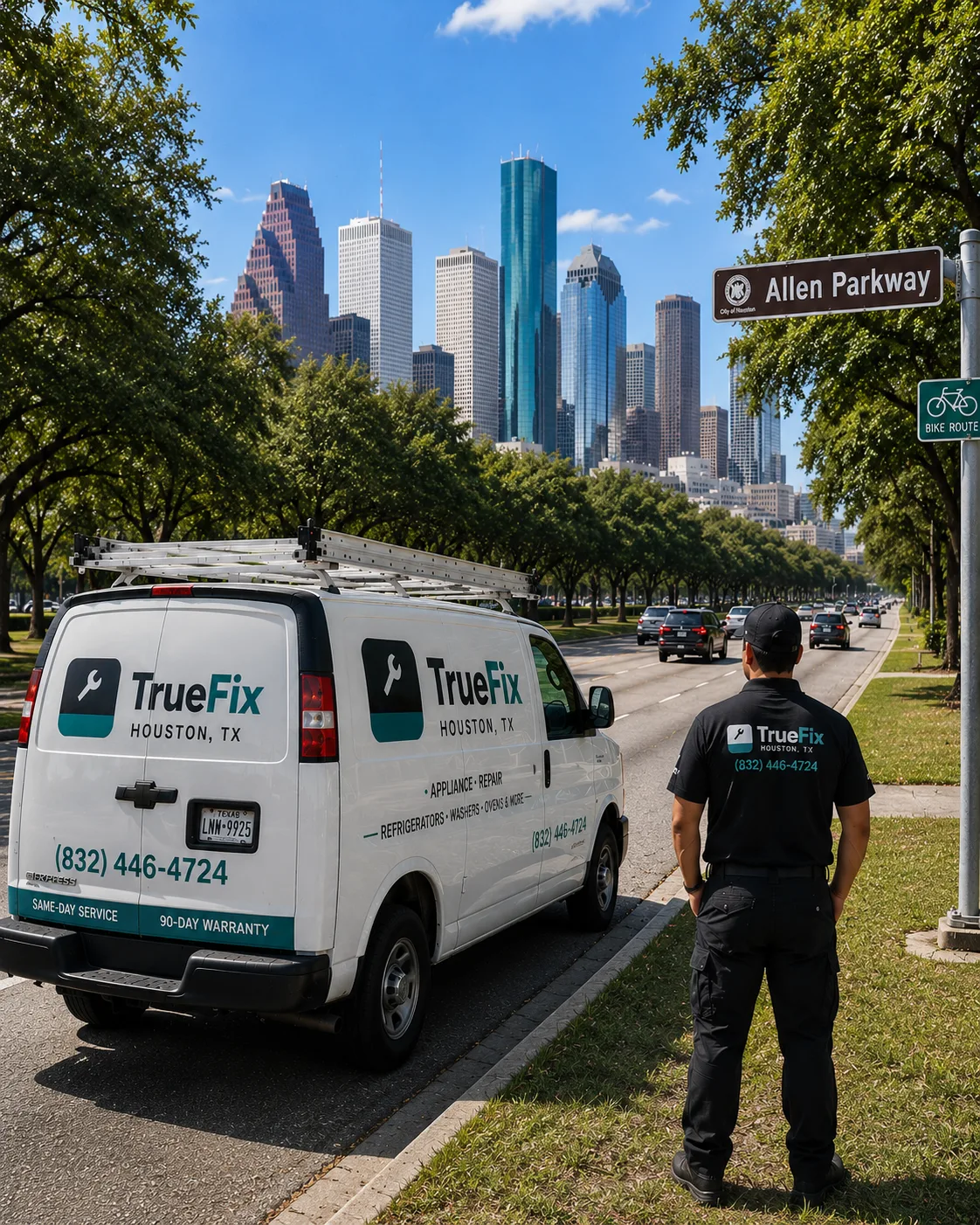
Built for Houston — Homes, Condos & More
True Fix Houston offers local Washer repair near you. Our certified neighborhood technicians diagnose and fix any Washer problem, from simple issues to complex repairs. We service Samsung, LG, Whirlpool, GE, Maytag, Bosch, KitchenAid, Frigidaire, Sub-Zero, and all other manufacturers. Book your Washer repair today for same-day service.
How a Call Actually Goes
Related Services
Certified Houston technicians across every appliance and brand we cover.
How Your Washing Machine Actually Works
Front-load and top-load washers solve the same problem - agitating clothes through water and detergent, then spinning most of the water back out - with different mechanics. A front-loader spins the drum on a horizontal axis and relies on gravity and tumbling to clean, which is gentler on fabric and more water-efficient, but it depends on a door boot seal to keep water inside the cabinet and on a drum suspended by bearings that take on real stress every time it spins at extraction speed. A top-loader with an agitator or impeller works the load mechanically at the bottom of a vertical tub, generally using a simpler direct-drive or belt-driven motor arrangement with fewer high-wear seal points.
Every washer, regardless of type, depends on a drain pump to expel wash and rinse water between cycles, a water inlet valve to meter incoming hot and cold water, a pressure or level sensor to know when the tub is full, and a control board to sequence the whole cycle. The drain pump is a small motor-and-impeller assembly that's directly exposed to whatever comes off clothing - coins, buttons, lint, small toys - and it's mechanically simple enough to fail from either a jam or straightforward motor wear. Front-loader bearings, by contrast, fail from cumulative stress: over years of high-speed spin cycles, especially with heavier loads, the bearing races wear and the drum develops play, which shows up as a grinding or roaring noise that gets worse over time.
Most modern washers use a motor control unit - a small circuit board dedicated specifically to regulating motor speed and torque - separate from the main control board that manages cycle selection and timing. That split matters diagnostically, because a washer that starts a cycle normally but fails partway through agitation or spin is often pointing at the motor control unit rather than the main board. An out-of-balance sensor, meanwhile, is what causes a washer to pause mid-spin and redistribute a load automatically; when that sensor malfunctions, a washer can either stop working on loads that are perfectly balanced or fail to catch a genuinely unbalanced load before it causes excess vibration.
What Houston's Climate and Housing Stock Mean for This Appliance
Houston's water is genuinely hard - high in dissolved calcium and magnesium - and that has a direct mechanical effect on washers over time. Mineral scale builds up inside water inlet valves and on internal heating elements in machines that use one for sanitize or allergen cycles, gradually restricting flow or causing the valve to stick partially open or closed. It also leaves a film on drum surfaces and can interact with detergent residue in ways that make front-load door seals feel gritty and wear faster. The region's humid subtropical climate compounds the seal issue in a different way: front-load door boots are already prone to trapping moisture in their folds, and Houston's humidity gives mold and mildew more opportunity to establish there, which shows up as both odor complaints and, eventually, seal degradation.
Housing layout plays a role too. Older homes in neighborhoods like Oak Forest or Highland Park sometimes have laundry set up in converted closets or small utility rooms with limited clearance, which makes it harder to get a washer perfectly level - and an unlevel front-loader vibrates more during spin, accelerating bearing wear. Newer stacked-unit installations common in townhomes and some The Woodlands-area properties are convenient space-wise but slower to service, since a stacked dryer typically has to come off before the washer's drain pump or belt is accessible.
Hard water changes how much detergent is actually needed to get clothes clean, and many households continue using the amount recommended on the box without adjusting for local water hardness, which leads to excess detergent residue building up inside the drum, the pump, and the drain hose over time. That residue buildup can slow drainage and, in some cases, trigger error codes that look like a pump failure but resolve with a deep-clean cycle and a change in detergent dosing. We also still encounter older sewer and drain line configurations in some historic-neighborhood homes that run slower than modern plumbing codes call for, which can make a perfectly healthy washer seem to drain slowly.
Common Failure Patterns We See and Repair-vs-Replace Guidance
Drain pump failure - whether from a lodged object or a worn motor - is the most common washer complaint we handle, typically showing up as a machine that won't complete a cycle or leaves standing water at the end of a wash. Door boot tears and leaks on front-loaders are next, often first noticed as water pooling in front of the machine. Bearing failure announces itself clearly: a loud grinding or rumbling noise during spin that gets worse as the load size increases. Water inlet valve failures, frequently mineral-related here, show up as slow fill times or a machine that won't fill at all. Control board failures are less common but do occur, often traceable to a power surge.
Drain pumps, door boots, inlet valves, and belts are all economical repairs relative to a washer's replacement cost, and we recommend fixing them without hesitation. Main bearing replacement on a front-loader is the one repair where the math gets closer - on some machines it requires substantial disassembly, and on a unit already eight or more years old, the labor cost can approach a meaningful fraction of a new washer's price. We walk customers through that comparison directly rather than defaulting to either option.
Control board failures, while less frequent than mechanical component failures, tend to cluster after severe electrical events - a lightning strike nearby, a grid surge during storm season, or a home's own electrical system having an issue - and we see a measurable uptick in washer control board calls in the days following major Houston storm systems. Unlike mechanical failures, board failures can sometimes present as erratic, hard-to-reproduce symptoms rather than a clean, consistent failure mode, which is part of why we test board function directly rather than assuming based on symptoms alone.
What a Service Visit Involves
A typical diagnostic starts with running the machine through a cycle to observe fill, agitation, drain, and spin directly, since that isolates which stage is failing. We check the drain hose and pump for obstructions, inspect the door seal for tears or embedded debris, verify the unit is level, and check inlet valve screens for mineral buildup. If a bearing is suspected, we listen through the spin cycle and check for drum play by hand before recommending disassembly.
We carry drain pumps, door boots, drive belts, water inlet valves, and the most common control boards on our trucks, which covers the majority of washer calls in a single visit. Every repair carries our 90-day parts and labor warranty.
For any washer complaint that isn't immediately obvious from a visual inspection, we run a complete cycle from fill through final spin while monitoring each stage, since some failures - particularly control board and motor control unit issues - only reveal themselves at a specific point in the cycle rather than at startup. We stand behind every completed repair with our warranty, and if a washer needs a part we don't carry on the truck, we prioritize getting it ordered and scheduled for a return visit as quickly as the supplier allows.
Washer Repair — What We See
These reflect how TrueFix Houston technicians actually diagnose and repair washer issues and come from our own job records.
Washer Repair — Common Questions
The questions our Houston dispatchers field most often. Can't see yours? Ask us directly — it takes a minute.
Still have questions?
Our Houston team is ready — same-day service across Harris County.
We diagnose the fault first, then give you one fixed price covering parts and labour. You approve it before any work starts, and it does not change afterwards. Call (832) 446-4724 to book a diagnosis.
Yes! We offer same-day Washer repair across the area. Book online or call (832) 446-4724 to confirm your appointment within minutes.
We repair all major brands: Samsung, LG, Whirlpool, GE, Maytag, Bosch, KitchenAid, Frigidaire, Sub-Zero, and all other manufacturers.
If your Washer is under 10 years old and repair costs less than 50% of replacement cost, repair is almost always the smart choice. Our technician will give you an honest on-site assessment.
Every Washer repair includes a 90-day parts and labor warranty. We stand behind our work.
Common Washer Problems We Fix
Faults our Houston technicians diagnose on washers most weeks.
- Not Spinning
- Not Draining
- Making Loud Noise
- Won't Start
- Leaking Water
- Not Filling with Water
- Door Won't Lock
- Vibrating Excessively
- Error Codes Displayed
- Not Agitating
- Clothes Not Getting Clean
- Washer Smells Bad
- Mold in Drum or Gasket
- Musty Odor Transferring to Clothes
- Door Gasket Mold
- Not Rinsing Properly
- Too Much Suds / Oversudsing
- Detergent Not Dispensing
- Fabric Softener Not Dispensing
- Bleach Dispenser Clogged
- Spin Cycle Stopping Early
- Not Completing Full Cycle
- Cycle Taking Too Long
- Pausing Mid-Cycle
- Filling Too Slowly
- Overfilling with Water
- Standing Water After Cycle
- Not Draining Completely
- Grinding Noise During Wash
- Banging Noise During Spin
- Squealing Noise
- Clicking Noise During Cycle
- Burning Smell from Washer
- Door Won't Open After Cycle
- Door Glass Cracked or Broken
- Door Seal / Gasket Torn or Damaged
- Leaking from Bottom
- Leaking from Door
- Leaking from Back of Washer
- Leaking from Detergent Drawer
- Drum Not Turning
- Agitator Not Working
- Agitator Dogs / Cogs Worn Out
- Drum Bearing Making Noise
- Drive Belt Broken
- Motor Failure
- Drain Pump Failure
- Water Inlet Valve Failure
- Lid Switch / Lock Failure
- Control Board Failure
- Water Temperature Wrong
- Washing Cold Only / No Hot Water
- Clothes Getting Damaged in Washer
- Tearing or Ripping Clothes
- Clothes Coming Out Tangled
- Soap Residue on Clothes
- Fabric Softener Spots on Clothes
- Rust Stains on Clothes
- Washer Won't Turn On
- Display / Control Panel Not Working
- Buttons Not Responding
- Pausing Randomly During Cycle
- Tripping Circuit Breaker
- Shaking the Floor During Spin
- Washer Moving Across Floor During Spin
- Not Balancing Load During Spin
- UE / Unbalance Error (LG)
- OE / Drain Error (LG)
- LE / Motor Error (LG)
- DE / Door Error (LG)
- 5E / SE Drain Error (Samsung)
- F21 Drain Error (Whirlpool)
- F5 / dL Lid Lock Error (Whirlpool / GE)
- Drum Bearing Replacement Needed
- Shock Absorbers Worn Out
- Spider Arm / Drum Support Broken
- Pump Filter Clogged
Washer Brands We Repair
Factory-trained technicians and genuine OEM parts across every major manufacturer.
SamsungLGWhirlpoolGEMaytagBosch KitchenAidFrigidaire
 Sub-Zero
 VikingKenmoreAmanaElectroluxMiele
 Thermador
 Wolf
Wolf Admiral
 AGA
AGA Asko
Asko Atosa
Atosa Avanti
 Bertazzoni
 Blomberg
 Dacor
Dacor DCS
DCS EverestFisher & Paykel
 Gaggenau
 Hobart
 Hoshizaki
 Hotpoint
 Insignia
 JennAir
 Keomatic
 La Cornue
 Manitowoc
 MaxxIce
 Perlic
 Roper
Roper Scotsman
 Sharp
Sharp SmegSpeed Queen
 Thor
Thor True
True Turbo Air
 U-Line
 Vulcan
Also serviced
- GE Profile
- Café
- Monogram
- BlueStar
- Liebherr
- Haier
- Hisense
- Panasonic
- Magic Chef
- Marvel
- Summit
- Danby
- NXR
- Beko
- Bertazzoni Professional
- Zephyr
- XO Appliance
- Forno
- ZLINE
- Verona
Related Articles
- Washing Machine Not Draining? Here's What to Check First
- Washing Machine Won't Spin: Common Causes
- Washing Machine Leaking Water: Find the Source
- Washer Vibrating and Shaking Violently? Do This
- Washing Machine Won't Start: Quick Checks
- Why Your Washer Smells — and How to Fix It
- Front-Load Washer Door Won't Unlock
- Washer Stuck Mid-Cycle: What to Try