
All Brands
Cooktop Repair Near You — All Brands
Fast, reliable local Cooktop repair — certified neighborhood technicians, all brands, same-day available.
Mon–Fri 7am–7pm · Sat 8am–5pm
Manufacturers We Are Trained On



















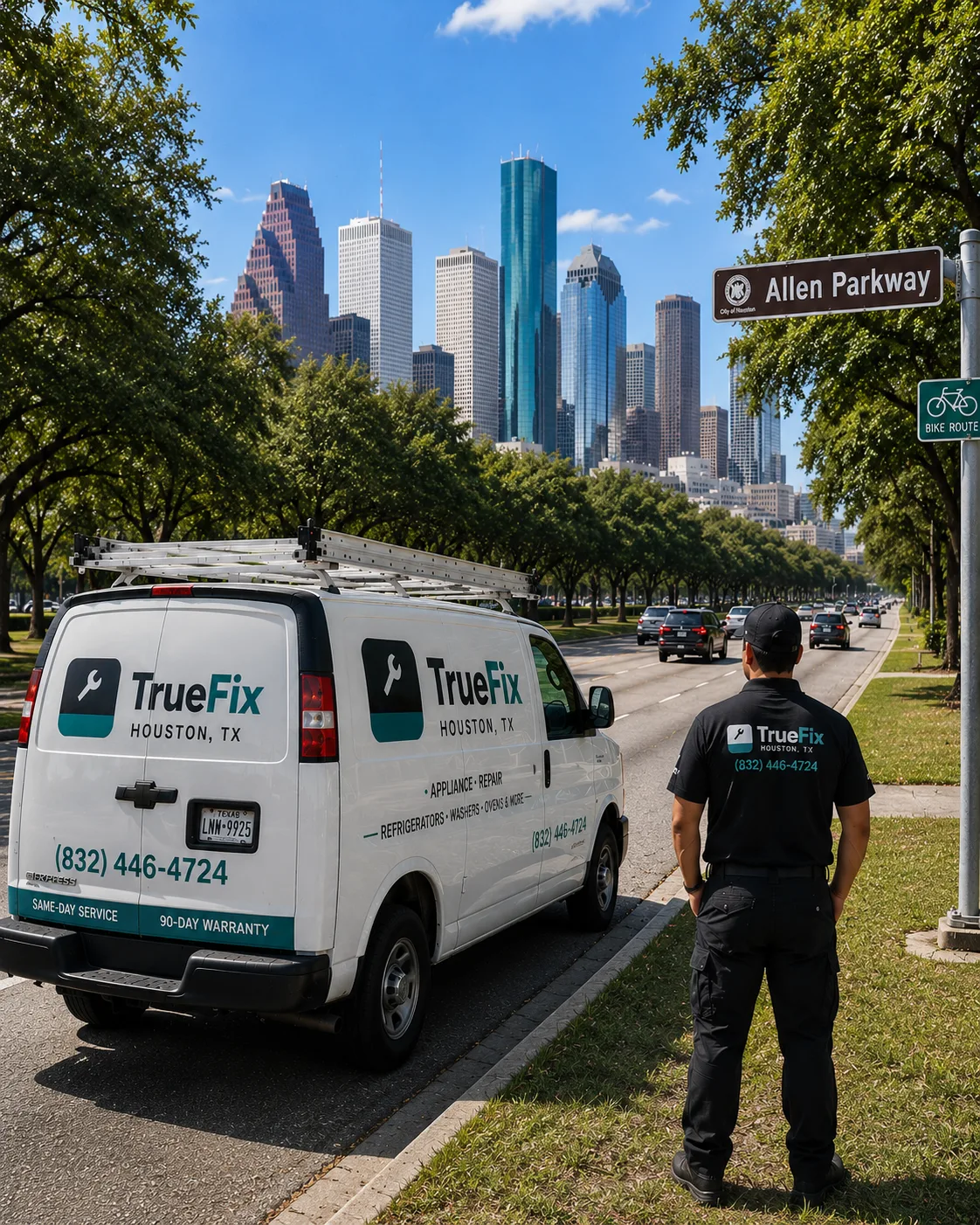
Built for Houston — Homes, Condos & More
True Fix Houston offers local Cooktop repair near you. Our certified neighborhood technicians diagnose and fix any Cooktop problem, from simple issues to complex repairs. We service Samsung, LG, Whirlpool, GE, Maytag, Bosch, KitchenAid, Frigidaire, Sub-Zero, and all other manufacturers. Book your Cooktop repair today for same-day service.
How a Call Actually Goes
Related Services
Certified Houston technicians across every appliance and brand we cover.
How Your Cooktop Actually Works
Cooktops split into three genuinely different technologies. Gas cooktops use burner valves that meter fuel flow and an electronic igniter that sparks continuously until the burner lights, with a thermocouple or flame-rectification sensor that shuts gas flow off automatically if the flame goes out - a safety feature, not just a convenience. Electric coil and radiant glass-top cooktops heat through resistance elements, either exposed coils or elements mounted beneath a ceramic glass surface, with the glass-top design depending entirely on that glass staying structurally intact to protect the elements and wiring underneath. Induction cooktops work differently still: rather than generating heat directly, they create a rapidly alternating magnetic field that induces electrical current - and therefore heat - directly inside ferrous cookware sitting on the surface, which means the cooktop itself stays comparatively cool and only works with induction-compatible pots and pans.
Each design has a distinct weak point. Gas cooktops most often fail at the igniter or the burner valve. Radiant glass-tops are vulnerable to the glass itself - a crack from a dropped pan or from thermal shock compromises the whole surface, not just one burner zone. Induction cooktops depend on a more complex electronic control board managing the induction coils and cookware detection, so failures there tend to be electronic rather than mechanical.
Some cooktops, particularly in kitchen islands without an overhead hood, use a downdraft ventilation system built directly into the cooktop unit itself, drawing cooking exhaust downward and out through ductwork below the floor rather than up and out through a hood - a fundamentally different venting approach with its own motor and damper mechanism that can fail independently of the cooking elements themselves, and one that requires a different diagnostic approach than a standard hood-vented cooktop.
What Houston's Climate and Housing Stock Mean for This Appliance
Glass-top cooktops are common in The Woodlands and other newer-construction kitchen remodels, and thermal shock cracking is a real risk that's slightly elevated by a specific Houston habit: pulling cookware straight from an air-conditioned refrigerator or a cool pantry into a kitchen that's already running warmer in summer, then setting cold cookware on a rapidly heating glass surface. The temperature differential involved in that sequence is exactly the kind of stress that causes glass-top cracking, and we see a modest seasonal uptick in crack-related calls through the hottest months for that reason.
Gas cooktops remain common in both historic downtown homes and newer construction, but the gas supply infrastructure differs - older homes sometimes have smaller-diameter gas lines or older shutoff valves that weren't sized for a modern high-output cooktop, which can show up as weak flame performance that looks like a burner valve problem but is actually a supply-side limitation. Induction cooktops are gaining popularity in Houston specifically because they add much less ambient heat to a kitchen during long cooking sessions - a genuine advantage during a summer where every extra degree from the stove works against the air conditioning.
Gas line infrastructure varies enough across Houston's older neighborhoods that we occasionally find cooktops still configured for liquid propane rather than natural gas, or vice versa, typically left over from a previous fuel source at the property - and a cooktop that seems to underperform or run an inconsistent flame is sometimes actually running the wrong orifice size for the gas type actually being supplied to the home, which is a straightforward fix once correctly identified but easy to misdiagnose as a valve or igniter problem.
Common Failure Patterns We See and Repair-vs-Replace Guidance
On gas cooktops, igniter or spark module failure is the most common call, usually presenting as a burner that clicks but won't light, or lights unevenly around the ring. Burner valve failure is next, often showing up as a flame that won't adjust properly or won't shut off fully. On electric radiant cooktops, individual element burnout is common and usually isolated to one burner zone continuing to work while another doesn't. Glass-top cracking from impact or thermal shock is a distinct and fairly frequent call on its own. Induction units more often present as control board faults - an error code, a zone that won't recognize compatible cookware, or a unit that won't power on at all.
Igniters, burner valves, and individual radiant elements are all economical, worthwhile repairs. A cracked glass-top surface is different: because the glass is the structural and electrical housing for the elements underneath, a crack generally requires replacing the entire cooktop surface as a unit rather than a single component, which pushes the cost meaningfully higher and sometimes close enough to a new cooktop's price that replacement makes more sense, particularly on an older unit.
Induction cooktops sometimes generate cookware-detection error codes that aren't actually a unit malfunction at all, but simply a pot or pan that isn't sufficiently ferrous-magnetic to couple with the induction field - stainless steel with an aluminum core, for instance, may not register properly depending on its construction. We always verify cookware compatibility directly before assuming an induction control board fault, since it's a common and entirely avoidable false-alarm repair call.
Knob and switch failures on electric coil and traditional gas cooktops round out the list of common issues, generally caused by years of the same twisting motion wearing down the internal contact points - a low-cost repair, but one that's easy to overlook until a burner setting becomes unreliable or a knob no longer clicks firmly into its detents. On gas cooktops specifically, the venturi tube beneath each burner - the passage that mixes gas with air before combustion - can accumulate debris over time if a cooktop sits unused for a period, producing a burner that lights but burns with a yellow, uneven flame instead of a clean blue one; this is a cleaning fix rather than a parts failure in most cases we see.
What a Service Visit Involves
We start with a visual inspection for cracks or damage on glass-top units, since that alone can determine the repair path. On gas units we test igniter spark and burner valve gas flow directly; on electric units we test element continuity and resistance; on induction units we read diagnostic codes where the control board supports it and test the induction coil driver circuits.
Our trucks stock igniters, burner valves, radiant elements, and common control boards, with glass-top surface replacements typically special-ordered to match the exact model given how many surface variations exist across brands. Every repair carries our 90-day parts and labor warranty.
For induction and radiant cooktop calls, we test performance with actual cookware on the surface rather than relying solely on diagnostic codes, since a code can point toward a general category of fault without confirming the cooktop's actual real-world heating performance.
For glass-top cooktop owners specifically, letting cookware come closer to room temperature before placing it on a hot surface, and avoiding setting cold or frozen cookware directly onto an active burner zone, meaningfully reduces the thermal-shock cracking risk discussed earlier - a small habit change that costs nothing and can meaningfully extend a glass-top surface's working life in a climate where the cold-fridge-to-hot-kitchen temperature swing is a real and recurring pattern. We pass this along during service visits even when cracking isn't the reason for the call, since it's one of the few genuinely preventable cooktop failures we see.
Cooktop Repair — What We See
These reflect how TrueFix Houston technicians actually diagnose and repair cooktop issues and come from our own job records.
Cooktop Repair — Common Questions
The questions our Houston dispatchers field most often. Can't see yours? Ask us directly — it takes a minute.
Still have questions?
Our Houston team is ready — same-day service across Harris County.
We diagnose the fault first, then give you one fixed price covering parts and labour. You approve it before any work starts, and it does not change afterwards. Call (832) 446-4724 to book a diagnosis.
Yes! We offer same-day Cooktop repair across the area. Book online or call (832) 446-4724 to confirm your appointment within minutes.
We repair all major brands: Samsung, LG, Whirlpool, GE, Maytag, Bosch, KitchenAid, Frigidaire, Sub-Zero, and all other manufacturers.
If your Cooktop is under 10 years old and repair costs less than 50% of replacement cost, repair is almost always the smart choice. Our technician will give you an honest on-site assessment.
Every Cooktop repair includes a 90-day parts and labor warranty. We stand behind our work.
Common Cooktop Problems We Fix
Faults our Houston technicians diagnose on cooktops most weeks.
- Burner Not Working
- Uneven Heat Distribution
- Won't Ignite
- Control Panel Issue
- Gas Smell
- Cracked Surface
- Gas Burner Not Lighting
- All Gas Burners Not Lighting
- Constant Clicking When Not in Use
- Weak or Low Flame
- Yellow or Orange Flame
- Electric Burner Not Heating
- Induction Burner Not Working
- Glass Smooth-Top Cracked
- Glass Smooth-Top Scratched
- Burner Knob Broken or Missing
- Control Knob Loose
- Gas Valve Failure
- Spark Igniter Electrode Failed
- Element Switch Failure (Electric)
- Burner Won't Turn Off
- Hot Surface Indicator Not Working
- Gas Smell Without Flame
- Error Code on Induction Cooktop
- Induction Cooktop Not Detecting Cookware
- E7 / E Sensor Error (Induction)
- Dark Burn Spot on Smooth-Top
- Electric Element Glowing When Turned Off
- Induction Cooktop Buzzing Noise
- Flex Zone / Expandable Element Not Working
- Burner Not Reaching Maximum Power
- Grill or Center Burner Not Working
- Cooktop Requiring Specific Cookware
- Warming Zone on Cooktop Not Heating
- Heat Spreading to Adjacent Burner Area
- Downdraft Vent Not Working
- Surface Element Only Works at Full Power
- Radiant Element Cracked or Burned
- Igniter Clicking Randomly When Not Cooking
- Low Pressure on All Gas Burners
- Glass Cooktop Cracked from Thermal Shock
- Induction Displaying H After Cooking
- Surface Element Heating Intermittently
- Gas Burner Lighting Wrong Burner
- Cooktop Not Powering On
- Not Sure If Cookware Is Induction-Compatible
- Ceramic Cooktop Surface Difficult to Clean
- Cast Iron Grates Rusting
- User Reports Burning Even Though Induction Is Cold
- Gas Supply Hose Needs Replacement
- Induction Zone Display Flashing
- Cooktop Surface Permanently Stained
- Electric Cooktop on Wrong Voltage
Cooktop Brands We Repair
Factory-trained technicians and genuine OEM parts across every major manufacturer.
SamsungLGWhirlpoolGEMaytagBoschKitchenAidFrigidaire Sub-ZeroVikingKenmoreAmanaElectroluxMieleThermadorWolf
 Admiral
 AGA
AGA Asko
Asko Atosa
Atosa Avanti
 Bertazzoni
 BlombergDacor
 DCS
DCS EverestFisher & Paykel
 Gaggenau
 Hobart
 Hoshizaki
 Hotpoint
 InsigniaJennAir
 Keomatic
 La Cornue
 Manitowoc
 MaxxIce
 Perlic
 Roper
Roper Scotsman
 SharpSmeg
 Speed Queen
 Thor
Thor True
True Turbo Air
 U-Line
 Vulcan
Also serviced
- GE Profile
- Café
- Monogram
- BlueStar
- Liebherr
- Haier
- Hisense
- Panasonic
- Magic Chef
- Marvel
- Summit
- Danby
- NXR
- Beko
- Bertazzoni Professional
- Zephyr
- XO Appliance
- Forno
- ZLINE
- Verona