

OEM Parts
Fisher & Paykel Dryer Repair Near You — Full Brand List
Local Fisher & Paykel technicians ready to fix your Dryer near you. Same-day appointments available.
Mon–Fri 7am–7pm · Sat 8am–5pm
Manufacturers We Are Trained On












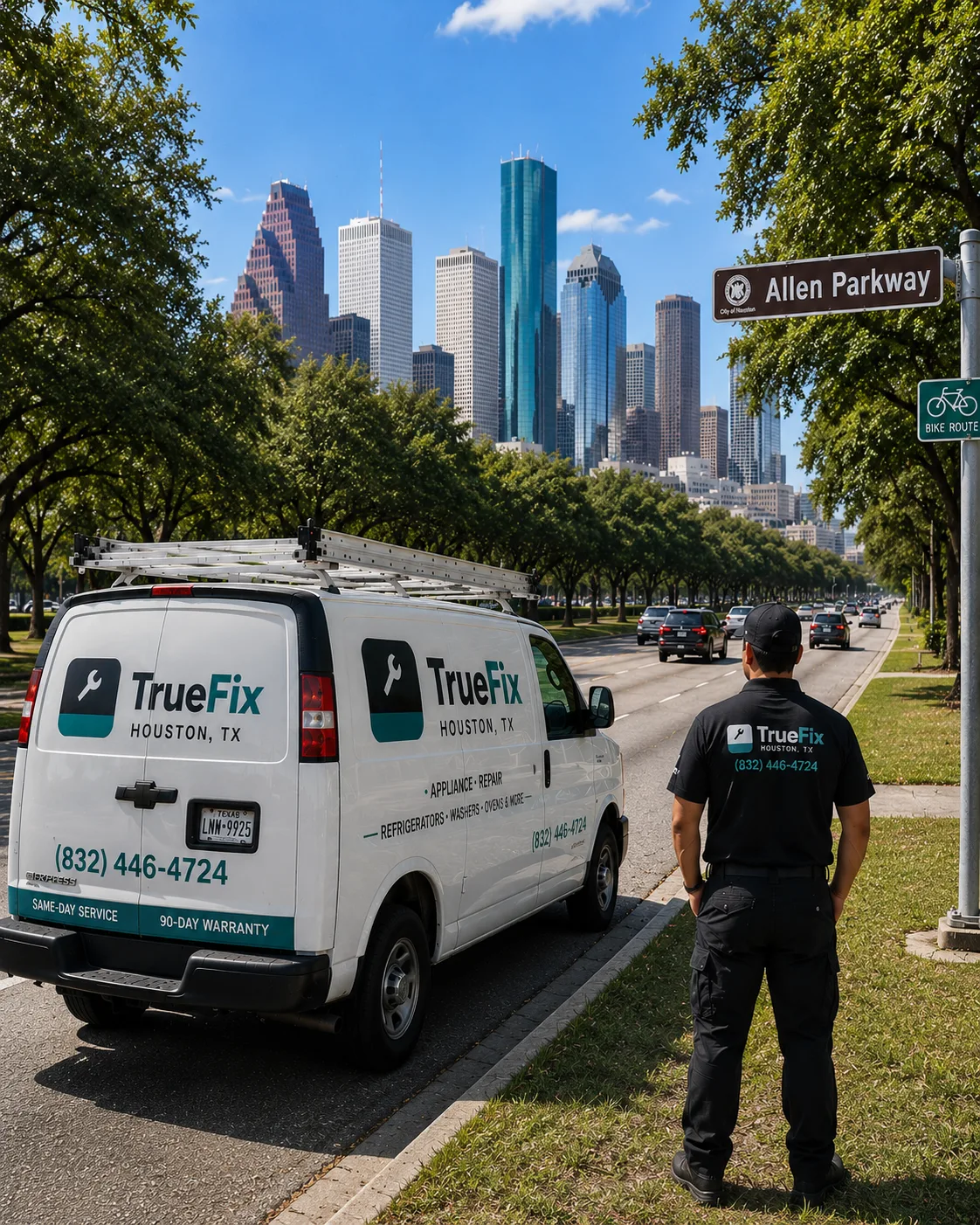
Built for Houston — Homes, Condos & More
True Fix Houston is your local provider for Fisher & Paykel Dryer repair. Our neighborhood technicians work on Fisher & Paykel equipment and access to genuine OEM parts. We repair all Fisher & Paykel Dryer models, handle all common problems, and back our work with a 90-day parts and 30-day labor warranty. Book online or call for same-day service near you.
How a Call Actually Goes
Related Services
Houston technicians across every appliance and brand we cover.
Fisher & Paykel dryer repair: what to know
Fisher & Paykel's US website today lists cooking, cooling, ventilation and dishwashing, with no laundry section at all. Every Fisher & Paykel dryer still working in a Houston home is therefore an older machine, and that changes the repair conversation more than any single fault does. The company's own serial-label guide names three dryer families it has supported: a general clothes dryer whose tag may be just inside the door or on its rear panel, the SmartLoad dryer labeled on the back, and the DE08/DG08 front-loading dryer labeled at the bottom of the door frame. SmartLoad is a model family with its own layout, so its service information has to be checked separately. The basic mechanics are familiar: a drum turned by a belt, an electric element or gas burner, thermostats, a thermal cutout and a lint path to the outside. What differs is parts supply. Before anything is ordered, the tech confirms that the specific part can still be had.
Faults we see on Fisher & Paykel dryers
Takes two or three cycles to dry
Long drying on an older Fisher & Paykel almost always starts outside the machine: a crushed foil duct behind it, or lint packed in the wall cap where the vent exits. Restricted airflow also makes the cutout trip and the element cycle off early. The tech measures airflow at the exhaust and clears the full run before testing heat parts.
Drum turns but stays cold
On an electric model, a heating element that has broken or a thermal cutout that opened after overheating stops the heat while the motor keeps running. Gas versions point instead to the glow igniter, the flame sensor beside it, or the solenoid coils on the valve. Each part is metered, and the tech looks for the venting problem that may have caused the cutout to open.
Thumping or squeal as the drum turns
Worn drum rollers, a glazed belt or a dry idler give a rhythmic thump or a high squeal that worsens over weeks. On a SmartLoad dryer the layout differs from conventional models, so the tech checks the model's own service information before taking the cabinet apart, rather than assuming a standard front-loader layout.
Dead at the button, or quits if the door gets bumped
A worn door switch or latch can drop out mid-cycle when someone bumps the door. If there is no response at all, the tech checks the outlet or gas-model cord, the thermal fuse, and the control's power supply. Old dryers with electronic controls can also lose a relay, which is tested before the board is condemned.
Burning smell at start-up
Lint that has escaped the filter collects around the element or burner housing and scorches when heat comes on. Stop using the dryer if the smell is strong. The tech opens the cabinet, vacuums lint from the heater area and the blower, and checks the filter housing seal that let it through.
Check these before you call
- Pull the dryer forward and straighten or replace any foil duct that has been crushed flat against the wall.
- With a load tumbling, step outside to the wall cap; its flap should lift and you should feel warm, moist air.
- Hold the lint screen under the tap; if water beads on it instead of passing through, scrub off the softener film with a brush and dish soap.
- For an electric model, check the breaker; a tripped half of a double breaker lets the drum turn with no heat.
- Note the full model and product code from the serial label before calling, so parts can be checked first.
Finding the model number
Fisher & Paykel's serial-label guide places the clothes dryer's label either within the door opening or on its rear panel, on the SmartLoad dryer it is on the back, and on DE08/DG08 front-loading dryers it is at the bottom of the door frame with the door open. Having it ready lets the technician bring the right part on the first visit.
Repair it or replace it?
With no current Fisher & Paykel laundry line in the US, the deciding question is whether the part can be had. Belts, rollers, thermostats, fuses and door switches are often available from general suppliers and are worth fitting. A failed control board or a model-specific motor that is no longer stocked is different. In that case, putting money into an older dryer makes less sense than replacing it with a model that has a current parts pipeline.
Fisher & Paykel dryer questions
Does Fisher & Paykel still sell dryers in the US?
Its US website currently shows cooking, cooling, ventilation and dishwashing products, with no laundry category. Existing dryers can still be repaired, but parts availability varies by model. Find the product code on the serial label first, so a technician can confirm the part exists before booking work around it.
Where is the label on my SmartLoad dryer?
Fisher & Paykel's serial-label guide puts it on the back of the SmartLoad dryer. Its five-digit product code begins with 9, and the serial number is printed on the same label. Take a phone photo of the label instead of copying it by hand, because one wrong character can bring up the wrong part.
Is a burning smell from my old dryer an emergency?
A faint dusty odor on the first heated load after weeks unused is not unusual. A strong or repeated smell, or any visible smoke, means stop the dryer, unplug it or shut off its breaker, and have the lint around the heater and the vent run cleaned before using it again.